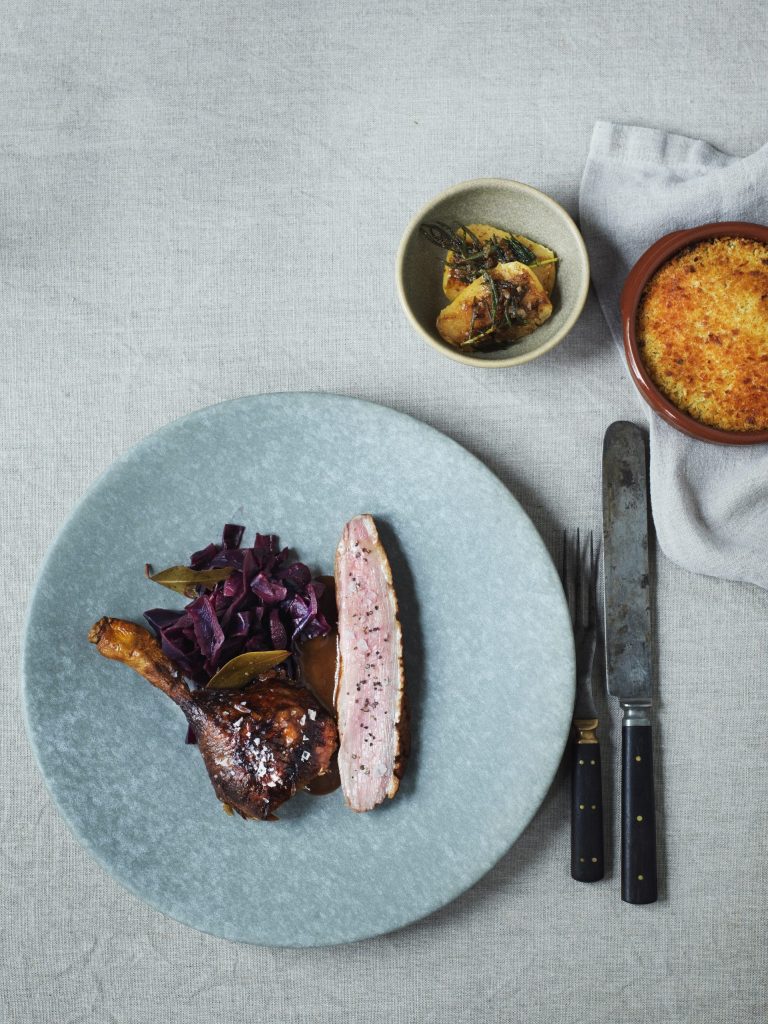
Here’s how to cook the perfect roast duck for your Christmas dinner and make a delicious duck sauce from the drippings. Serve the duck with classic accompaniments of browned potatoes and red cabbage.
Ingredients
See video guides here
Instructions
Start by preparing the duck.
Remove the loose flap of fat attached to the rump. Cut off the two wings and the neck. Rub the duck thoroughly with salt, inside and out. Leave it to rest for 1–2 hours at room temperature.
Meanwhile, prepare the roasting juices. Clean the vegetables and cut them into large chunks. Add a little oil to a frying pan and heat it well. Add the vegetables, wings and duck neck. Let everything brown slowly and thoroughly. Do not stir constantly, but leave it to cook on its own for several minutes at a time, so that it browns well.
Add thyme, salt and pepper after about 15 minutes. Let everything brown for a further minute or so, then pour in the wine. Let the wine reduce almost completely, then add stock or water until it is generously covered.
Let the stock simmer on a very low heat for a good hour before pouring it into the roasting tin with the duck. Preheat the oven to 250 degrees.
If the duck is not dry-cured and dry on the outside, pat it dry with kitchen roll, both inside and out.
Rinse the apples. Cut them into wedges, peel them and remove the cores. Peel the shallot and chop it very finely.
Place the apples, shallot and prunes in a bowl and toss thoroughly with salt, pepper, thyme and apple cider vinegar.
Stuff the duck with as much of the mixture as you can possibly fit inside. Close the duck with meat skewers and tie the wing joints and thighs to the body with cotton string.
Place the rack over the oven roasting tin. Place the duck on the rack, breast-side up, and put it in the oven. Leave it to brown for approx. 20 mins.
Remove the duck and roasting tin from the oven. Turn the oven down to 160 degrees. Pour the fat (into a saucepan) that has dripped into the roasting tin during browning. Pour the prepared gravy into the roasting tin under the duck.
Turn the duck so that it is lying with its back facing upwards on the rack.
Return the duck and roasting tin to the oven and leave to roast for approx. 2 hours. It is IMPORTANT that the roasting tin with the juices does not boil dry during cooking; if necessary, add a little more water or stock to the roasting tin if it is starting to boil dry.
After 2 hours, remove the duck and turn it so that it is once again breast-side up, then roast at 200°C for a further approx. 30 mins.
Insert a skewer into the thickest part of the thigh to check if the duck is cooked through. The juices that run out should be completely clear.
If the skin isn’t quite crispy, you can put the duck back in an oven preheated to 250–275 degrees for about 10 minutes. Remember to take the duck out whilst the oven is heating up. Pour the cooking juices from the roasting tin and set them aside for the sauce before putting the duck back in the hot oven.
Leave the duck to rest for 20–30 minutes before carving.
Remember to remove the lovely apples and prunes from the cavity and serve them with the duck, along with the red cabbage, the browned and white potatoes, and the delicious gravy!
Once the duck is roasted: Scrape the bottom of the roasting tin with a wooden spatula. This will loosen the bits of fat and juices that have stuck to the pan.
Pour the juices and fat from the roasting tin and skim off the fat. Brown about 300 ml of the duck fat with 4–5 tbsp of plain flour. Add the gravy from the roasting tin and the reduced stock.
Let the sauce boil down thoroughly. It should reduce to about 500–600 ml. Add 100–200 ml of cream.
Season the sauce with salt and pepper and a little apple cider vinegar or redcurrant jelly, and add extra cream if desired.